My Role
UX Writer responsible for:
Creating a structured voice framework at company level
Translating brand values into practical writing rules
Problem
Garmie needed a defined tone of voice to speak to its eco-conscious, fashion-forward millennials (18–30). At the time, the brand lacked consistent language and had no guidelines to direct content across channels.
Solution
Create a tone of voice framework that:
Reflects Garmie’s brand identity and aligns with its audience
Ensures consistency across all channels
Guides internal and future contributors
Approach
Define brand principles
I started working with the CEO and internal teams to define what Garmie should feel like to its audience. I interviewed stakeholders and together, we defined Garmie’s 3 core principles - ‘youthful’, ‘advisory’ and ‘camaraderie’.
These principles defined what the product wants to be to the people who use it.
Translating principles into a usable framework
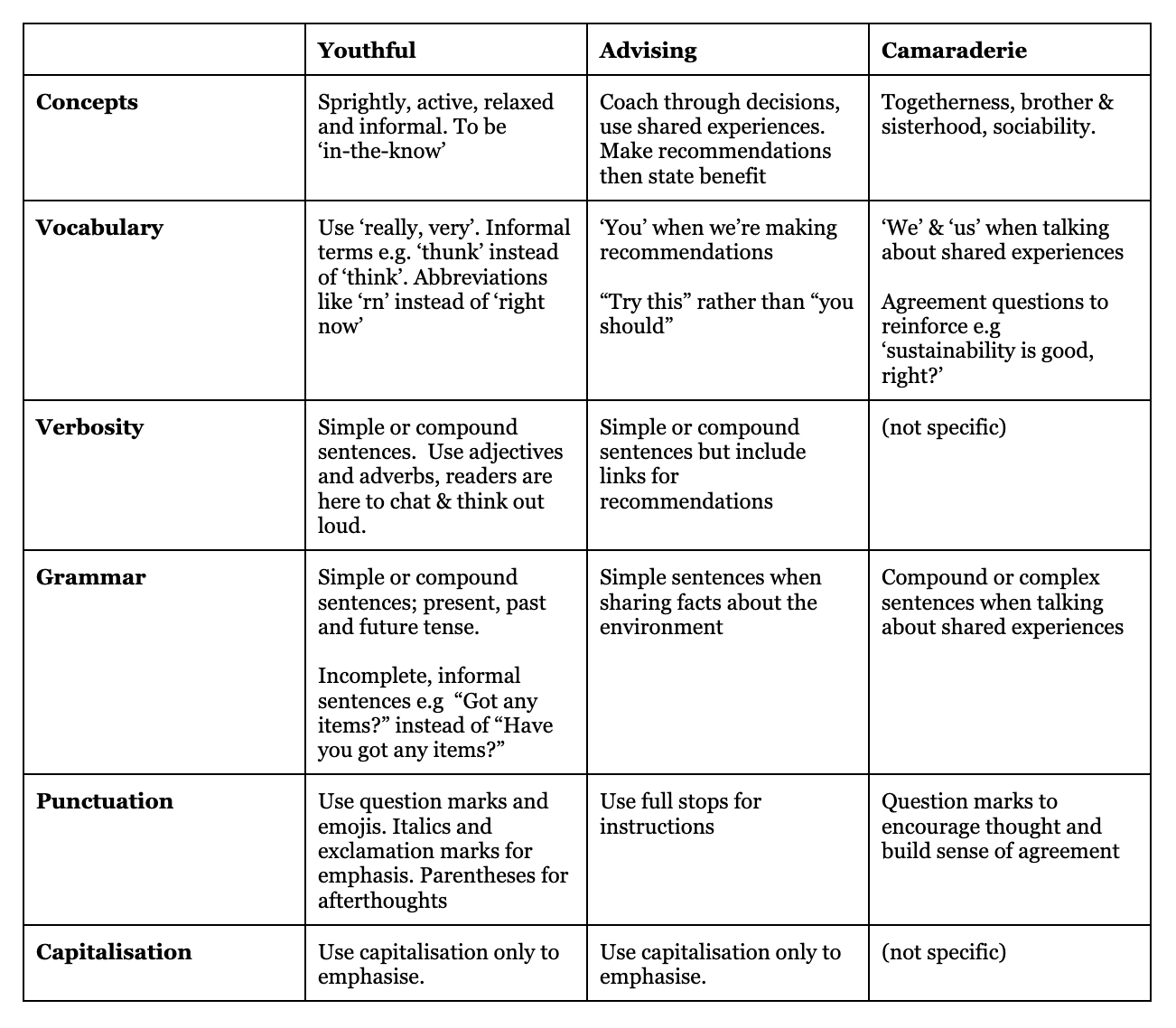
To move from brand values to a framework, I created a voice chart. A voice chart defines what language, grammar, and punctuation support or undermine each brand principle. It lays the rules for how the brand should speak to its audience to convey each principle.
With this, we turned concepts into language rules to guide new and existing contributors.
Outcome
Given the small team and early-stage nature of this company, validation was based on internal feedback rather than large-scale testing. Nevertheless, we had a scalable internal standard. Once implemented, 100% of staff said that the brand personality felt “more defined”.
While informal, this suggests an increased understanding of the brand personality, eliminating the "guesswork" from content creation.
With a new structured voice chart and practical writing rules, we reduced time spent on editorial reviews and feedback loops. The framework now serves as a live document to onboard future contributors.